
AI Capability Installation
AI that stays after we leave.
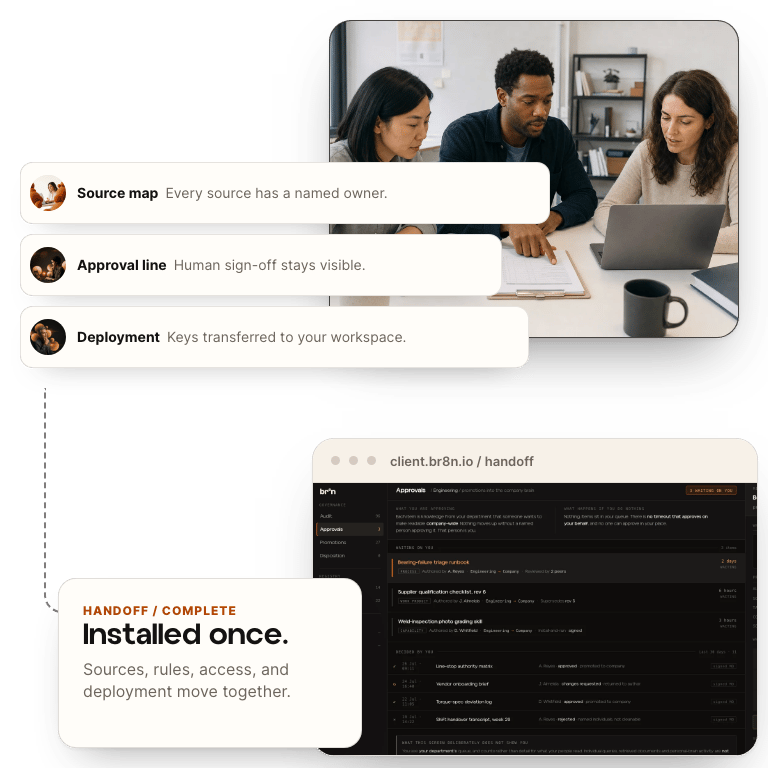
Tools, workflow, people, and governance installed as one operating capability. Your team runs it. Your organization owns it.
The category
A running capability, not a recommendation.
Installation builds AI into work the organization already does. The system goes live with operators, written boundaries, and a transfer plan.
The finish line is independence: the operation keeps running without renting the installer forever.
A report tells you what to build. An install leaves the capability running.
The method
Four layers move together.
Map
See the real work
Locate the knowledge, repetition, handoffs, risk, and first process worth changing.
Install
Build inside it
Connect source material and AI tools to the workflow people already use.
Transfer
Run, govern, own
Train the operators, document the boundaries, prove the work, and hand over the system.


What changes
Same topic. Different finish line.
| Compare | Consulting | Managed service | Installation |
|---|---|---|---|
| Deliverable | Recommendation | Rented outcome | Running capability |
| Who builds | You, afterward | The vendor | Installer + your team |
| Who runs it | You, if built | The vendor | Your team |
| At the end | The report | Service stops | Ownership transfers |
The operating test
The technology worked. Did the work change?
Pilots stall when the model succeeds but the surrounding operation stays the same. Installation treats adoption and governance as build work. See the rules in Trust and Security, or the knowledge layer in context engineering.
- Operators can run the capability without the installer.
- Source material and access boundaries are documented.
- Models can change without rebuilding the operation.


Make the capability yours
Find the first install point.
Bring one process that repeats, one role carrying too much context, or one pilot that never became normal work.
FAQs
What is AI capability installation?
The practice of building AI capability inside an organization — into its existing workflows, its people, and its governance — so the organization runs it without the vendor after the engagement ends. The deliverable is not a report or a tool. It is an operation that works differently and owns the difference.
How is AI capability installation different from AI consulting?
Consulting diagnoses and recommends; you still have to build what the slides describe. Installation does the build inside your operation, runs it with your team, and transfers ownership before leaving. A consultant leaves you knowing what to do. An installer leaves you already doing it.
How is it different from an AI implementation or integration project?
Implementation deploys software. Installation treats the tool as one layer of four: the tool, the workflow it lives in, the people who run it, and the governance around it. Skip the other layers and a pilot often stalls when its champion leaves.
Do we need an AI team before an installation?
No. The install is how the team capability gets built. Existing operators learn to run the system as it goes into work they already do, keeping the capability inside the operation instead of in a lab beside it.
What does an AI capability installation cost?
At the individual scale, br8n publishes its numbers: a Working Intelligence Audit runs $497 to $997 and a Personal Brain install runs $1,497 to $4,997. Company installs start at $15,000 plus a retainer and run two to six months, priced after a diagnostic because the honest number depends on how many workflows and people the capability has to reach.
Which AI vendor does an installation lock us into?
None, if it is done right. The capability is structured to be portable across model vendors, with corpora in open formats, retrieval over open protocols, and governance that names vendors as replaceable parts. When a better model ships, you swap the engine rather than the operation.
What do we own when the installer leaves?
Everything the operation needs to keep running: the brains and corpora, workflow integrations, governance documents, and the trained habits of the people who run it. br8n keeps its delivery engine, the internal tooling and methods used to perform the install.
Can't find what you're looking for? Talk with us