
Context Engineering
What the AI stands on when you ask.
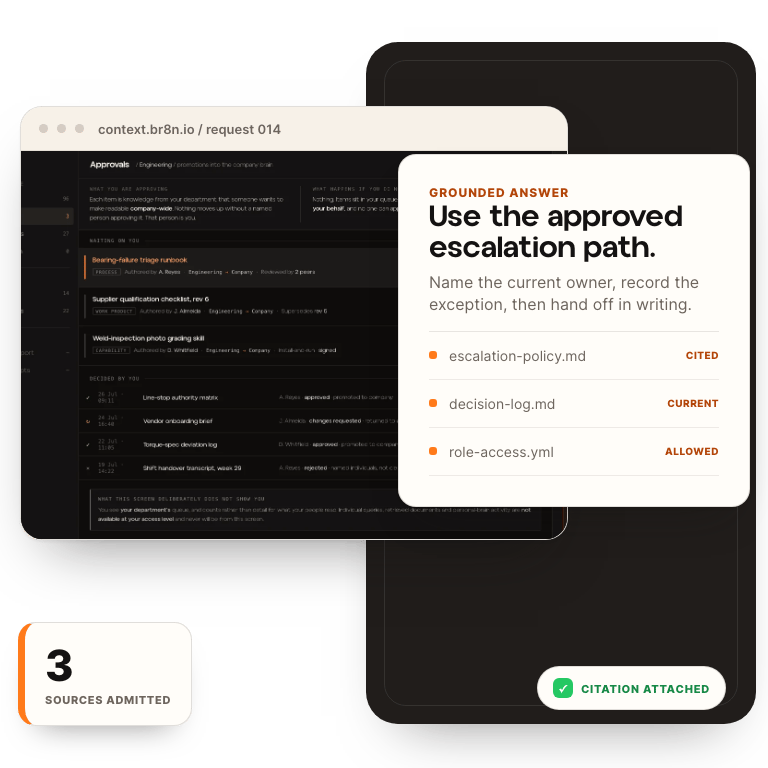
The sources it can retrieve. The state it remembers. The boundaries around what it may reach. That layer decides whether the answer is grounded.

The discipline
Engineer the context beneath every request.
Prompting changes the wording of one ask. Context engineering builds the standing system beneath every ask: curated source material, memory that persists, and access rules the operation can defend.
When that system exists, ordinary language can produce informed work because the model starts from the right material.
A strong model over thin context still guesses. A grounded system changes the answer before the prompt begins.
The three layers
Know. Remember. Reach.
Retrieval
Pull the right source
Find the current contract, decision, project history, or operating rule at the moment of work.
Memory
Carry state forward
Keep decisions, client history, and project state available after a chat session ends.
Governance
Bound the reach
Write down which roles, sources, vendors, and actions are allowed, then log what happens.



Prompting vs. context
One improves an ask. One improves the system.
| Compare | Prompt engineering | Context engineering |
|---|---|---|
| Scope | One request | Every request |
| Shapes | How you ask | What the system knows and can reach |
| Lives in | A person’s phrasing | The operation |
| Accumulates | Prompt library | Corpus, memory, and rules |
At org scale
The context belongs to the operation.
The company owns the knowledge, the obligations, and the decisions about access. An installer can build the layers and transfer them. That is the context work inside an AI capability installation.
- Sources are curated instead of dumped into a vector store.
- Memory has an owner and a maintenance rhythm.
- Access and exclusions are agreed before data moves.

Find the thin layer
Make the next answer stand on something real.
Bring one recurring question, the source material behind it, and the tools where the answer needs to appear.
FAQs
What is context engineering?
The discipline of shaping what an AI system knows, remembers, and can reach at the moment of work. It covers what material the system retrieves, what persists between sessions, and what boundaries govern access. Prompting decides how you ask. Context engineering decides what the system is standing on when you ask.
How is context engineering different from prompt engineering?
Prompt engineering tunes the wording of a single request. Context engineering builds the standing system underneath every request: the corpus the model can retrieve from, the memory that carries across sessions, and the rules about what it may touch. A good prompt over empty context still produces a confident guess.
Is RAG the same thing as context engineering?
Retrieval-augmented generation is one layer of the discipline. RAG answers what documents the system can pull in right now. Context engineering also covers memory, which persists between sessions, and governance, which controls who and what the system may reach.
What does context engineering look like inside a company?
A curated corpus built from the company’s own material, retrieval wired into the tools people already use, standing memory for recurring projects and clients, and written boundaries for what the system can see per role. The visible symptom is mundane: people stop re-explaining the business every morning.
How do you keep sensitive data out of the context?
Set governance boundaries before anything moves: which sources enter the corpus, which roles can retrieve what, which vendors process which data under which agreement, and what the audit trail records. Exclusion is a design decision made in writing ahead of time.
Do bigger context windows make context engineering unnecessary?
No. A larger window changes how much you can load per request. It does not decide what should be loaded, what persists after the session ends, or what the system is permitted to reach. Selection and ownership still matter as windows grow.
Can't find what you're looking for? Talk with us