We map your actual work — the tools, the gaps, the shape your role needs.
01 · Brain Lifeline
Pay-per-call advisory.

One-hour sessions, scheduled async. Prepaid 10-hour block: $1,250 ($125/hr effective).
Builders, agency owners, operators with focused expertise needs at the unit level. People already shipping with AI who hit a specific wall.
For the moment when you don’t need a project. You need someone who’s already been there, for one hour, to look at the thing.
How it works
Diagnose. Build. Hand you the keys.
One method, three moves: we map your actual work, build your private brain from it, and hand you the keys — owned, portable, queryable from anywhere.
We build your private brain from it — your corpus, indexed and queryable.
It's yours. Reach it from any LLM, at your own subdomain. You own it.
Bring a problem. Leave with a direction.
Pay-per-call advisory — no project, no commitment. Just the thinking, when you need it.
A stuck decision, an agent that won’t behave, an architecture you’re unsure of. Drop it in plain language — no prep required.
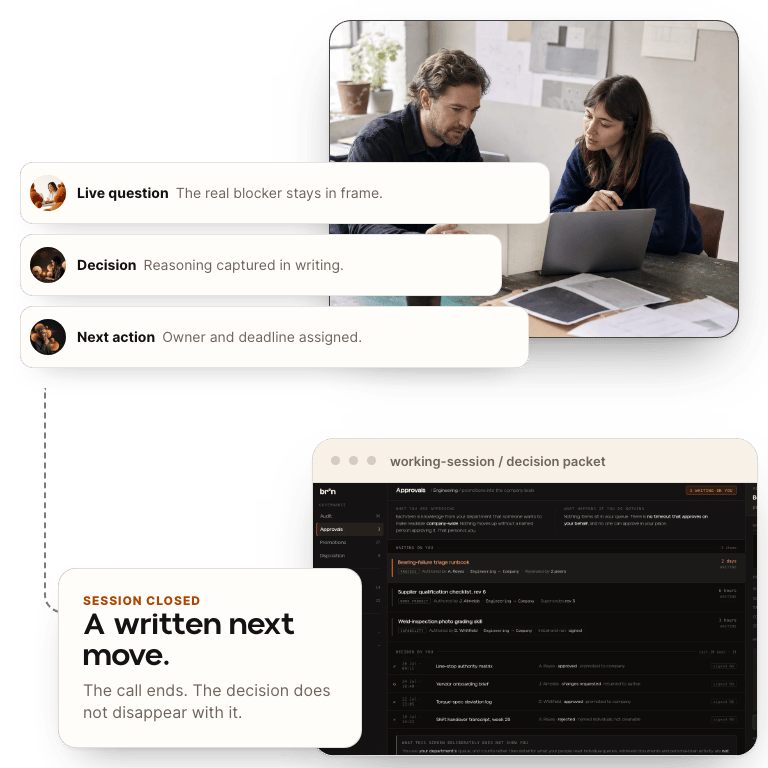
A considered read on what you’ve already built and what to do next — written down so you can act on it after the call.
No retainer, no lock-in. Come back by the hour whenever the next problem lands — and the fee credits forward if you install.
There’s a frustration that doesn’t have a name yet.
You’ve built something with AI, it’s mostly working, and there’s a knot in it.
- You’ve already shipped.An agent that handles a workflow you used to do by hand. A Claude project trained for six months that finally sounds like you. A tool stitched from API calls and a prompt you keep tweaking. It’s mostly working. You’re shipping faster than you used to.
- And there’s a knot in it.Not a bug. A knot. You can feel the shape is wrong but can’t articulate it cleanly enough to Google — and asking the model produces confident answers in three directions.
- What you need is an hour.Not documentation, not a contractor, not a year of mentorship. An hour with somebody who’s already untied that exact knot and can tell you what they see.
The homepage talks about being the humans between you and every AI vendor. The Brain Lifeline is the smallest version of that promise — billed by the hour, scoped to a single conversation, no project commitment either way. You bring the problem. We bring three years of building this stuff full-time.
“You don’t need a project. You need an hour with someone who’s been three turns ahead of where you are right now.”
What’s actually broken.
The AI consulting market has a hole in it, and most operators live right in the middle of it.
- The market skips the middle.On one side, $20/month subscriptions. On the other, $50,000+ enterprise engagements where someone in a suit assesses your AI maturity over a quarter. Between them is where most operators live — and there’s almost nothing built for them.
- So you improvise. Post on a Discord and hope someone with context is reading. Burn three hours on conflicting Twitter threads. Book a call with a vendor whose job is to sell you their tool, not look at yours.
- The real cost is downstream.Not the hour you’d spend solving the knot with a colleague who’s been there. The three weeks you spend solving it without one — and the architectural decision at the end you live with for two years.
Most of what people pay us for in these calls is the thing we almost don’t want to charge for: telling them the question is wrong. "Should I use vector search or full-text" turns out to be downstream of a decision they hadn’t made about how the corpus gets updated. The fix is upstream. An hour pays for itself the moment that gets clear.
Stop tweaking
Book the call. Bring the knot.
One hour. $150. No project commitment. You leave with a punch list and the option to keep going.
The shapes we see most often
Four kinds of knot.
Architecture review
You've built an agent. It works in dev. You can feel it's going to break under load. We open the repo together and we tell you what we'd worry about and what we wouldn't.
Tool-stack question
Claude or GPT for a specific workflow. MCP server or custom backend. Cursor or Claude Code. We've usually built the thing you're deciding about.
Prompt or context knot
A Claude project or custom GPT that's 80% there. Hallucinates on one thing. Loses the thread after three turns. Most are unsticky in twenty minutes once someone external looks.
Buy-vs-build read
Your team is evaluating an AI product. We tell you what we know, what the smart and not-smart versions look like, and where the category is heading.
What you walk away with.
Something you can act on Monday — plus the option to keep going, and a clear line on what this isn’t.
- A doc you can act on.A shared notes doc with everything we covered, written as we went. Next steps named by name — not "consider exploring retrieval options" but "swap to BM25 for the doc-tree side, keep vectors for the conversational side." Plus a follow-up paragraph by email next day.
- The option to keep going.Once we’ve done one call we have context — the second goes deeper, faster, same hour. Some clients book one hour. Some book the 10-hour block ($1,250, $125/hr effective) across a quarter. No commitment either way.
What this isn’t: project work. We don’t write the code, build the brain, or take the work home. If the answer at the end is "this needs more than a conversation," that’s when we talk about the Audit or the Install. The Lifeline holds the line at thinking together.
How a session is structured
Sixty focused minutes, async around.
- BEFORE
Pre-read
You send a paragraph through the booking form: what you've built, what's in front of you. If there's a repo, you share access. We spend 15 minutes reading before we meet.
- 0–10
Context check
We tell you back what we think the problem is. You correct us. We agree on what the hour is actually for.
- 10–50
Work
Code on screen, notes in a doc, sometimes a whiteboard. The goal isn't to look smart — it's for you to leave with something you can use.
- 50–60
Punch list
Three things to do, in order. Two things you were worried about that turned out not to matter. What would make the next hour worth it, if there is one.
Who this is for
Named by role.
- The agency builderYou’re shipping AI work for clients. You’ve hit an architectural decision that’s above your current level. You don’t want to learn the hard way on your client’s timeline.
- The solo operatorYou’ve built tools for your own business. They’re working. You can feel one of them is fragile and you can’t find anyone in your network who’s already solved it.
- The technical founderYou’re making a buy-vs-build call on an AI capability. The vendor pitch sounds great. You want a read from someone who isn’t selling it.
- The internal AI leadYour company put you in charge of "AI" without giving you a peer who ships with it. You need somebody to talk through the next decision with, briefly, without a six-month engagement.
What’s included
In the price.
- 60 minutes of focused, scoped conversation
- Pre-read of the materials you send ahead of time
- Real-time shared notes doc — yours to keep
- Three specific next steps, named explicitly
- Follow-up paragraph by email within 24 hours
- Honest read on what you should and shouldn’t worry about
- References to specific docs, tools, or threads when relevant
- No project work — that’s a different offer (see below)
Common questions
Asked, answered.
Why $150/hr — that seems both high and low?
Deliberately calibrated. High enough that you only book when there’s an actual question — which keeps the conversations dense. Low enough that one hour pays itself back the moment you avoid a bad architectural decision. The 10-hour prepaid block ($1,250, $125/hr effective) is for operators who’ve done one call and want a budget for the quarter.
What if the answer to my question is "you need the Install"?
Then we’ll tell you that, and we’ll spend the rest of the hour scoping it instead of pretending it’s a one-hour problem. You don’t pay extra for the hour just because the answer was larger than the question. And if you decide to upgrade to a Personal Brain or a Company Install, the Lifeline fee credits against it.
Can I just keep booking these forever instead of paying for the Install?
You can. Some clients do — usually the ones with engineering capacity in-house who just want a periodic gut-check. If the cumulative spend starts exceeding the Install price, we’ll say so. We’re not optimizing for keeping you on the meter.
Do you do these for free as a "discovery call"?
The free version is the Diagnostic Call — 30 minutes, scoped to whether you should even be talking to us, no work product. The Lifeline starts where the Diagnostic ends: you already know you want our time on a specific question, and the hour is for the question, not the qualification.
What if my question is about a tool you haven’t used?
Say so when you book and we’ll be honest about whether we’re the right people. Where we’ve worked deeply: Claude (Code, Cowork, projects, API, MCP), ChatGPT (Custom GPTs, API, agents), Cursor, Workers AI, Vectorize, D1, Supabase, postgres pgvector, Convex, n8n, Zapier. On something exotic we may still be useful for architecture, but we’ll flag where our read thins out.
Can my team join?
Yes, up to four. More than that and it stops being a working session and becomes a workshop — a different offer (Workflow Sprint or Closed Cohort). Two-to-four is the sweet spot for aligning an internal team on a specific decision.
How quickly can you get on a call?
Usually within a week. Sometimes within 48 hours if the schedule allows. The booking link shows real availability. If you have a hard deadline (a board meeting, a launch date), say so in the form and we’ll move things around if we can.
What’s your refund policy?
If the call doesn’t produce something you can act on, you don’t pay. We’ve had two of those in three years; both times the client got the refund and we figured out a better offer for what they needed. The bar is your judgment, not ours.
This engagement runs through the Lab.
Onboarding is a course you keep. Worksheets land where we read them before every call. When we’re done you hold the workbook, the certificate, and the method — not a slide deck about it.
See the Lab →Book the Lifeline. Or the Diagnostic first.
The Diagnostic Call (30 minutes, free) is the first step if you’re not sure the Lifeline is what you need. The Lifeline is for when you already know the question — book directly below.