
Run Your Own Working Intelligence Audit
The self-guided diagnostic. Score your real capability with evidence, sort your actual tasks, name your install targets, and leave with a one-page audit report plus a 90-day plan on your calendar.

Part of The Install Track · certificate on completion
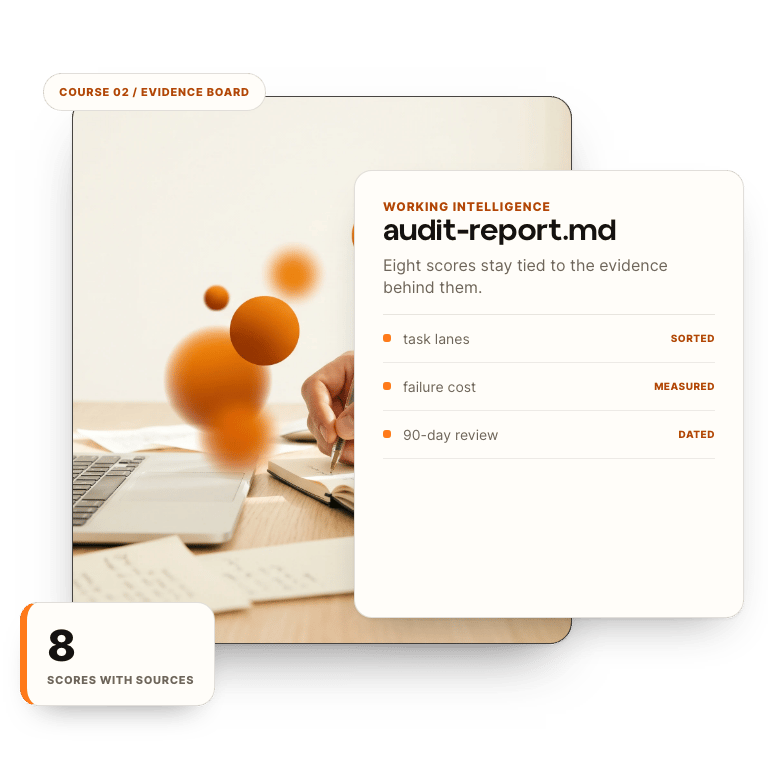
You leave holding work.
- Score yourself on eight working-intelligence capabilities, each backed by evidence you pull from your own work
- Decompose your role and sort every task into automate-now, verify-soon, or stays-human
- Score every audited workflow on the delegation surface (1–5): where it sits today, where it could sit, and the gap that names your first install
- Match your install targets to the capability layers they fix, with a starter drill for each
- Produce the one-page audit report your 90-day re-audit measures against
- Self-diagnostic
- Capability scoring
- Task decomposition
- 90-day planning
There are 4 modules in this course.
4 modules · each ends in a worksheet your answers save to · Last verified 2026-06-17 against the current frontier model lineup (Claude Opus/Sonnet, GPT-5-class, Gemini 3-class).
02.1Set Up Your Audit
You don't audit from a framework. You audit from the receipts. Before any scoring, before any theory, you put your real work on the table — the chats you actually ran, the tasks you actually repeat, the minutes they actually cost. The 'I'm not a technical person' story dies here, because nothing in this module asks you to build anything; it asks you to look honestly at what you already do. This is a judgment task, not a click task, so give it the full sitting — by the end you have a quantified leverage map of your own operation, which is the one thing every later module pulls from. This module shows the FULL worked install end-to-end (Dana, founder of a 4-person brand & marketing studio, steps 1 through 4) so you see the whole shape before you build any part of it unaided. Dana arrives with the studio's leverage map already in hand from the last course — five timed tasks, weekly client status updates at the top — and turns it into evidence here.
- Pull three real artifacts from your own AI-assisted work in the last 30 days and paste them into your audit doc as dated evidence
- Quantify your top-5 recurring tasks with minutes-per-run × runs-per-week, named in your business's words, not generic ones
Do thisOpen a blank doc, paste your three most recent AI chats or AI-assisted deliverables, date each one, and list your five most-repeated tasks this month with a time cost beside each (in the worked example, Dana lists the studio's: 'weekly client status update — 40 min × 4 = 160 min/mo', social caption batch, proposal draft, kickoff brief, monthly client report). If any line could belong to any business, rewrite it until it could only be yours — Dana's 'do client comms' became 'weekly status update per active retainer client.'
02.2Diagnose: Where You Are
A score without evidence is a guess wearing a number. So every one of the eight capabilities gets a citation — this chat, that deliverable, this step that broke. You direct the AI to draft the read-out, then you correct it, because the skill this track sells is judging the output, not accepting it. The before-state time log is the quiet workhorse: it's the baseline your 90-day re-audit subtracts from, and without it 'hours saved' is a story you can't prove to a client, a partner, or yourself. In the worked example, Dana scores the studio against the eight, citing the actual weekly-status-update chat as the receipt for each number. The eight, two per layer of the audit: context capture and context deployment (domain encoding); instruction craft and task triage (workflow calibration); output judgment and delegation & escalation (behavioral relationship); asset building and verification & maintenance (demonstrated capability). Each one is defined where you'll actually use it — inside the scoring prompt below.
- Score yourself on all eight working-intelligence capabilities with one piece of pulled evidence cited per score, no bare numbers
- Audit one real recurring workflow end to end and log its before-state time so the saving is measurable later, not guessed
Do thisPick the single workflow from your Module 1 list that costs the most minutes per month (in the worked example, Dana's studio picks the weekly client status update at 160 min/mo). Walk it step by step, score each of the eight capabilities 1–4 against your pulled evidence, and write the before-state time log: every step, who does it, how long it takes today. Then have an AI draft your capability read-out and red-pen where it inflated a score you can't back with evidence — Dana cut an inflated 3 on 'delegation' back to 'unknown' because no chat proved it.
02.3Prescribe: What to Install
Prescription is where most audits turn into a wish list. You're not making a wish list. Each install target points at a specific task with a specific time cost, and you prove the smallest one works before you write it down as a plan. You direct the drill, evaluate the output against your own standard, and iterate once — the create-feedback-iterate loop, run on your real operation. What survives is a short, ordered list of installs that each already showed a result on a task you actually do. In the worked example, Dana's two weakest scores point at the studio's weekly status update and its social caption batch, and Dana runs the caption batch as the starter drill.
- Match each of your two lowest-scoring capabilities to a named install target and the specific recurring task it would fix
- Run one starter drill against a real task and capture the before/after so the prescription has a result attached, not a promise
Do thisTake your two weakest capability scores from Module 2. For each, name the install target (a prompt, a routing change, a delegation pattern, a captured context file) and the exact recurring task it attacks (in the worked example, Dana points one install at the studio's weekly status update, one at the social caption batch). Then run the smaller of the two as a starter drill on real work right now, and log what changed: time, quality, or steps removed — Dana ran the caption batch and logged 25 min down to 8. A prescription with no test result attached doesn't clear.
02.4Make It Stick: Your Report
An audit that lives in your head decays in a day — 70% of it gone in 24 hours without a return trip. So the report is one page you'll actually re-read, and the reviews are on the calendar before you close the course, each one aimed at your own numbers rather than abstract recall. The dated, exported one-pager is the deliverable and the proof at once: it's what your re-audit measures against, and it's the artifact you'd hand a partner to show exactly where the leverage in your operation sits today. In the worked example, Dana ends with a one-page 'Studio Working Intelligence Audit' — eight evidenced scores, the five studio tasks sorted, install targets ranked — and books the three reviews to re-open it.
- Assemble the one-page Working Intelligence Audit: eight evidenced scores, sorted tasks, ranked install targets, and total hours-at-stake
- Book the 24-hour, 1-week, and 1-month review touchpoints on your real calendar, each pointed at re-surfacing your own artifacts
Do thisCompile your evidence, scores, time logs, and prescriptions into a single page (in the worked example, Dana's page totals the studio's hours-at-stake across the five tasks at the top). Put total monthly hours-at-stake at the top and the dated re-audit line at the bottom. Then create three calendar events — tomorrow, in a week, in a month — each titled to re-open this exact report (Dana titles them 'Re-open Studio Working Intelligence Audit', not 'review AI stuff'). Export the page as a dated PDF.

Michael Sebastian
I install AI for operators. The Lab is where the method is taught, and where my clients onboard. This course is that method.
More about me →

The Install Track
Start with the free course — this one unlocks on the way.
This course is $397 on its own. All five together are the Track — $1,197, where buying them one at a time runs $1,985. Course 01 unlocks this one — the chain matters, each course feeds the next its raw material.
Live-class attendees: your $100 credit applies. Or enter the Lab directly.
FAQs
Do I need a technical background?
No. The track is written for operators, not engineers. If you run a business or a role and you’re honest about where you actually are, you have the prerequisites.
How long does this course take?
Lessons are short on purpose — one idea per screen. Most people finish a course in two or three sittings. The worksheets take longer, because they’re real work on your real business. That’s the point.
What does the $497 option add?
Our eyes on your audit. $497 is the Working Intelligence Audit course plus our written review — we read your submissions and send a one-page response: what your scores say, and what to install first. It’s the bridge between self-serve and working with us directly.
Can't find what you're looking for? Talk with us