

Your team already has a way to follow up, prepare meetings or keep sales records current. The useful question is whether a specific change improves one task inside that routine.
Use this comparison when the current process is describable: someone can explain what starts the task, which records it uses and who receives the result. If those basics are unclear, first document the routine. This guide assumes it exists.
1. Choose one repeated task
Keep the surrounding sales process in place. Select a task such as preparing a meeting brief or drafting a follow-up for an account owner to approve.
Write its trigger, source records, current steps, output and person using the result. Define acceptance in terms of the work: correct account, supported facts, required commitments, review and the result in the agreed destination. A polished draft is insufficient if the next employee cannot use it.
2. Compare three ways of reaching that result
Describe the current human process. Then check whether a configuration of an existing tool can meet the same requirement. Verify the actual feature, plan, access, limitations and configuration before treating that alternative as available.
Finally, describe a bounded AI-assisted option. Name the sources it may use, the draft or action it may produce and the decisions reserved for a person. Include preparation and the work of reviewing and correcting it.
Do not assume every CRM has the required capability or that an AI assistant can reach the records safely. “Unverified” is a legitimate cell in the comparison.
3. Follow the result to the person who needs it
For each option, trace source → output → approved action → check in the tool → person who needs the result.
If the task ends at a draft, the account owner must accept the draft for the existing next step. If it includes a record update, specify who authorizes it and check the record after execution. If it includes sending, use the existing approved sending process and verify delivery as appropriate. Preparing an action is not evidence that it happened.
Rehearse a missing source, conflicting information and a failed handoff. Keep the current process available as a fallback.
Worked fictional example
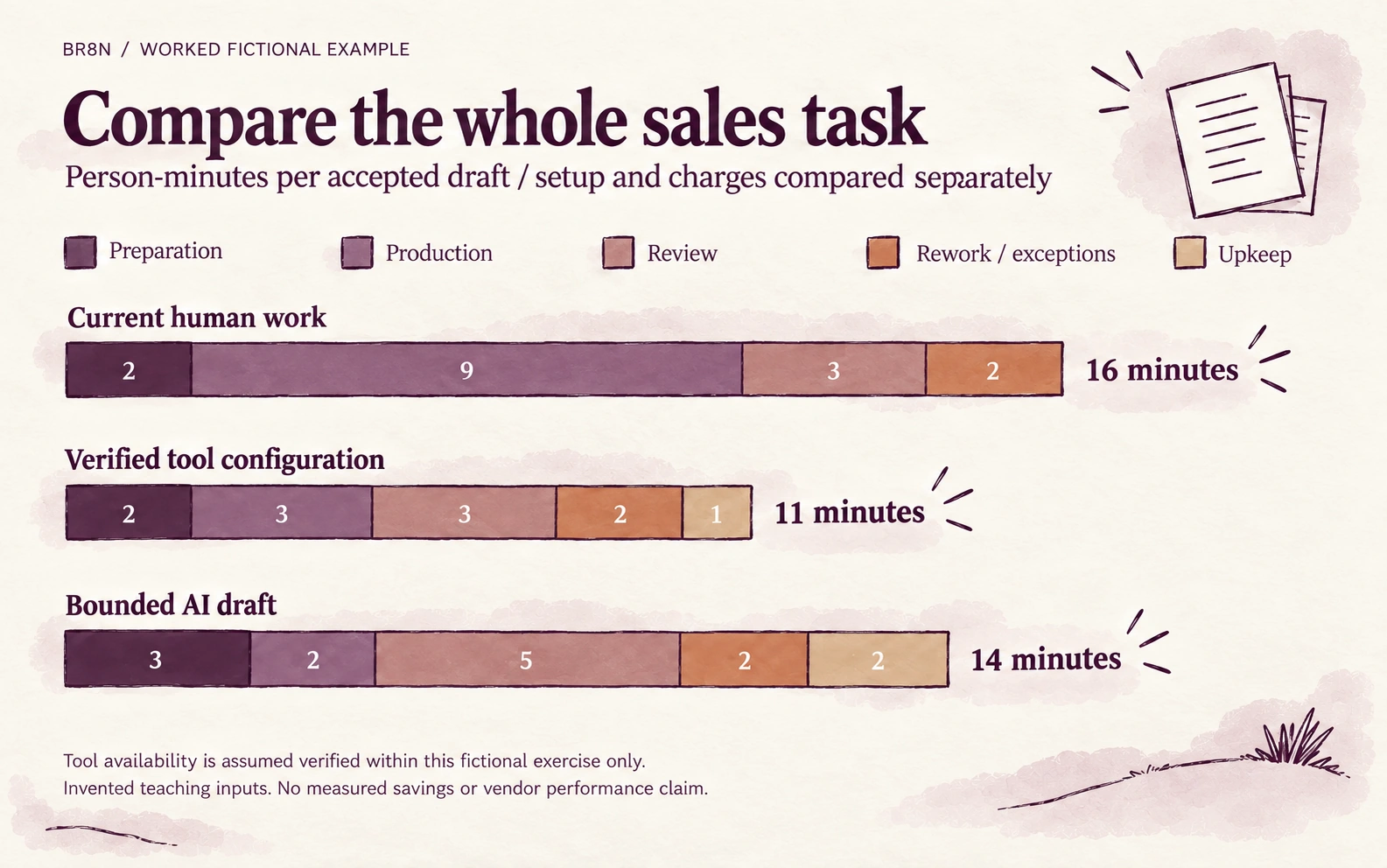
| Option | Preparation | Production | Review | Rework / exceptions | Upkeep | Total person-minutes |
|---|---|---|---|---|---|---|
| Current human work | 2 | 9 | 3 | 2 | 0 | 16 |
| Verified tool configuration | 2 | 3 | 3 | 2 | 1 | 11 |
| Bounded AI draft | 3 | 2 | 5 | 2 | 2 | 14 |
A sales team already holds discovery meetings, records notes and assigns follow-up to the account owner. It is comparing preparation of a follow-up draft, not redesigning that routine.
Every option must produce a draft that includes only supported commitments, marks unresolved questions and is accepted by the account owner. No option sends automatically. In this invented comparison, the team assumes it has verified an appropriate configuration in its existing tool. The example does not establish that a particular vendor offers the feature.
| Option | Preparation | Production | Review | Rework/exceptions | Upkeep allocated per draft | Total person-minutes |
|---|---|---|---|---|---|---|
| Current human work | 2 | 9 | 3 | 2 | 0 | 16 |
| Verified tool configuration | 2 | 3 | 3 | 2 | 1 | 11 |
| Bounded AI draft | 3 | 2 | 5 | 2 | 2 | 14 |
In the AI case, review catches a date unsupported by the notes. The owner removes it before accepting the draft. A case where that error escaped review would fail acceptance and could not be credited as a quicker successful task.
The configuration is the more promising next test on these fictional time inputs. Setup, charges and representative quality testing still need comparison. These numbers establish no real saving, revenue effect or readiness for wider use.
4. Include what it takes to operate
List setup, employee practice, source upkeep, permissions, corrections, failed connections and support for each option. Use the same planning period and task volume. Keep one-time setup separate from recurring effort.
Ask the account owner whether review is practical in a busy week. Ask the maintainer what changes when fields, sources or responsibilities change. A small per-task improvement may disappear once those responsibilities are counted.
5. Make a proportionate decision
Choose a limited test, a configuration check, further investigation or no addition. Name the evidence and owner needed to revisit the choice. A decision to defer AI applies to the proposed addition; it does not tell the team to stop its existing sales routine.
If the selected alternative passes representative quality and effort checks, discuss a small release with clear permissions, fallback and ownership. More automation is a separate decision.
Where this comparison stops
If the team cannot describe the current routine, document it before comparing additions. Resolve who may access the sources and approve actions before testing with real records.
Your next action: choose a repeated task and write the accepted result once. Use it to check all three options with the person who needs the result.
The blank Existing-process comparison card is available by email, without a Field Notes subscription. This guide remains open, and your completed card stays in your own files.
Use the matched-task measurement method to count review, unsuccessful attempts and upkeep.
For help comparing or scoping the options, book the diagnostic call. You can also contact BR8N.