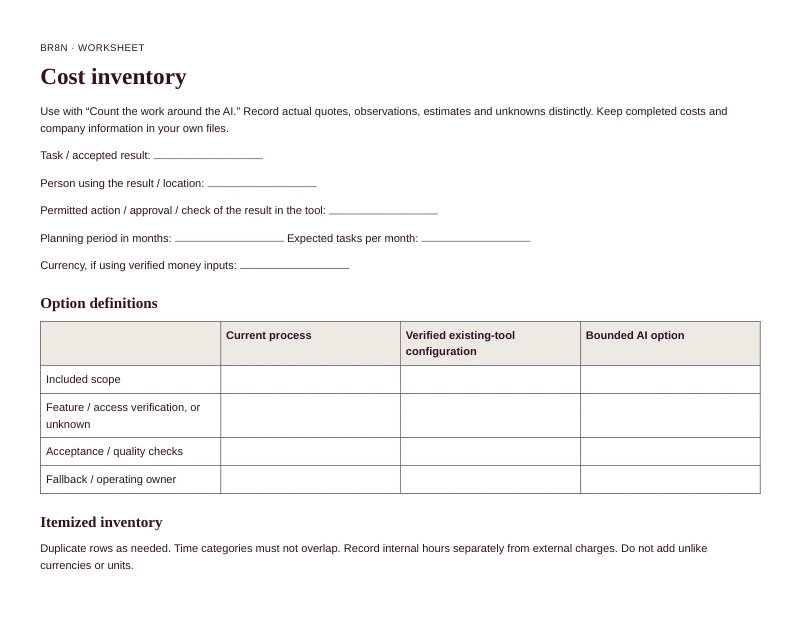

A subscription price tells you little about the cost of changing a workflow. Someone still has to prepare sources, arrange access, test the result, review exceptions and maintain the connections.
Use this inventory when comparing ways to improve one company task. It helps a sponsor, operator and maintainer discuss the same scope. It is a planning aid, not a quote or a promise of return.
1. Give every option the same result
Describe the accepted output and the person receiving it. Include any authorized action and the check that confirms it happened in the tool.
Compare the current process, a configuration of an existing tool where the required feature has been verified, and the proposed AI-assisted option. If one option produces a draft and another completes an approved update, their costs are not yet comparable. Either align the scope or show the difference explicitly.
Choose a planning period and expected volume. State the assumptions so another person can change them. Keep “unknown” visible; it is not zero.
2. List one-time setup
Include discovery with employees, source cleanup, access work, configuration or engineering, integration, test preparation, evaluation, training, handover and a fallback plan. Name the person doing each part.
Record internal hours separately from external charges. Use an actual rate or quote only when you have one, with its currency, date and included scope. A broad market estimate cannot establish the price of your project.
Existing subscriptions may already be paid for. That does not make employee configuration and testing free. Note whether a charge is already committed, incremental or unresolved so the comparison does not quietly charge one option twice.
3. List recurring work and charges
Record production time, preparation, review, correction and exception handling. Use mutually exclusive time categories: a correction minute goes in correction, not also in review.
Add upkeep: source reviews, connection changes, access reviews, support, retesting and the time needed to handle failures. Some work happens per task; other work belongs to the month or a specific change. Keep those units separate until calculating the chosen period.
List subscription, usage or support charges only from current verified information for the actual account and plan. Where usage varies, show the assumption and how it will be checked. Do not assume a native capability is included until someone verifies availability, permission and limits.
Worked fictional example
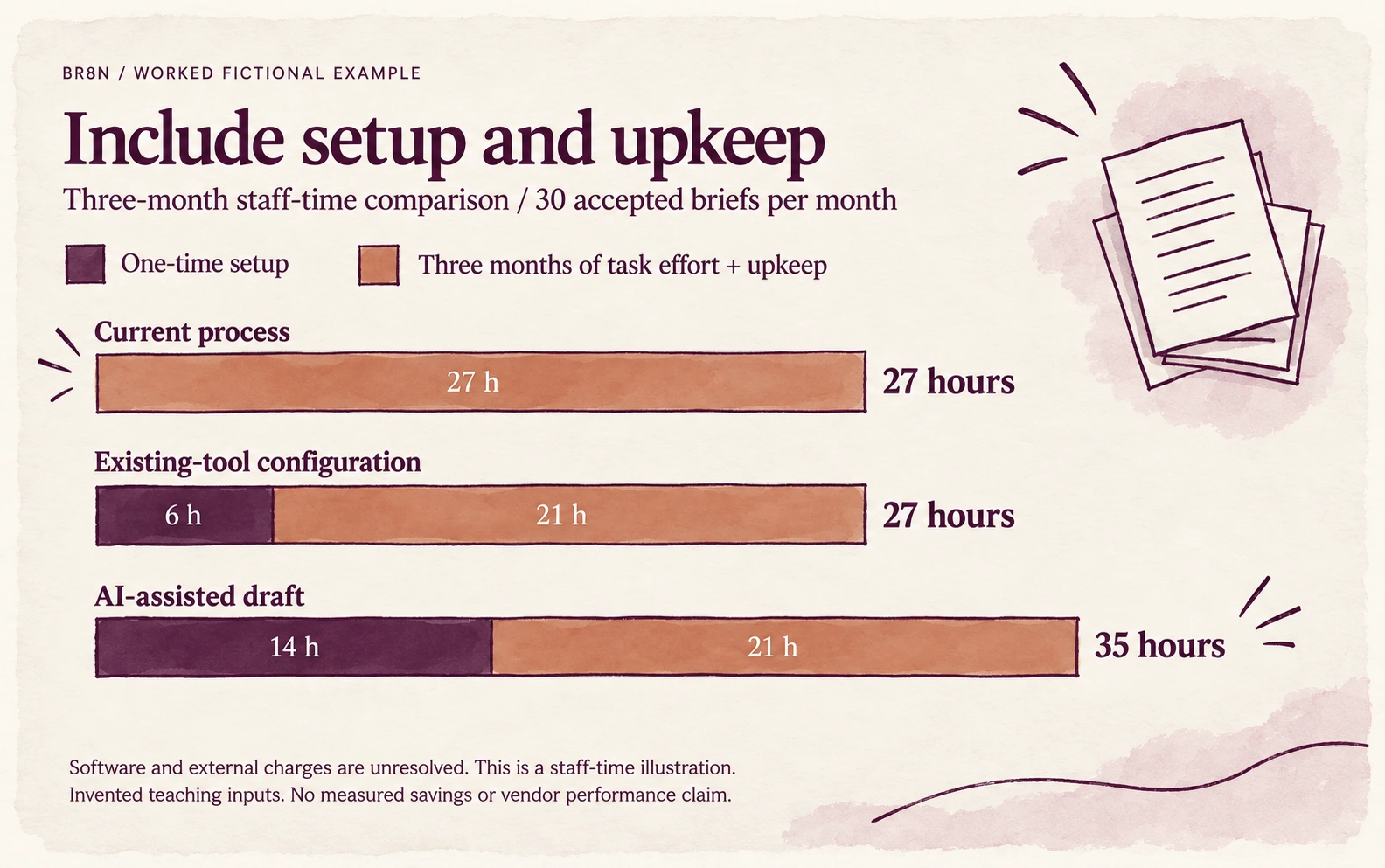
| Option | Setup hours | Three-month recurring hours | Total staff hours |
|---|---|---|---|
| Current process | 0 | 27 | 27 |
| Existing-tool configuration | 6 | 21 | 27 |
| AI-assisted draft | 14 | 21 | 35 |
A team wants an account brief accepted by its account lead before a meeting. All options must include open commitments with source references. None sends a customer message.
For a planning exercise, the team uses 30 briefs per month and these invented time inputs:
| Option | Setup | Person-minutes per accepted brief, including review and corrections | Monthly upkeep |
|---|---|---|---|
| Current process | 0 hours of new setup | 18 | 0 hours of new upkeep |
| Existing-tool configuration, subject to verification | 6 hours | 12 | 1 hour |
| AI-assisted draft | 14 hours | 10 | 2 hours |
On these fictional assumptions, monthly staff time is 9 hours for the current process, 7 hours for the configured option and 7 hours for AI. The latter two totals include upkeep once: 30 × 12 ÷ 60 + 1, and 30 × 10 ÷ 60 + 2.
For a three-month planning period, setup plus recurring staff time is 27, 27 and 35 hours respectively. The AI draft looks faster per brief while requiring more time over this short period. These are invented illustrations, not measured savings, vendor capabilities or prices. Software and external charges remain unresolved; this is not a complete financial comparison.
4. Make the uncertainty useful
Mark each entry as observed, quoted, estimated or unknown. Record its source and owner. Ask which uncertainty could change the decision: review effort, source quality, task volume, setup scope or a usage charge.
Test the consequential assumptions before committing to a wider release. Try a lower volume or higher review burden and see whether the preferred option changes. Do not present a single optimistic total as certainty.
5. Decide who owns the ongoing work
Put names against source upkeep, failed connections, review and support. Agree how changes will be requested and scoped. Ongoing support may be useful, but it is a separate choice; include only the support actually proposed.
If a cost or responsibility is unresolved, name what must be checked next rather than filling the cell with a convenient guess.
Where this inventory stops
Time and charge estimates are only part of a company decision. Check whether the options produce usable results, and identify what the team would do with any released time. Revenue gains would need separate evidence.
Your next action: add the employee review and maintenance work to the option you are currently considering. Ask its proposed owner to check the estimate.
The blank Cost inventory is available by email, without a Field Notes subscription. The guide stays open. Keep your completed inventory in your own files.
For observed effort in a trial, use the matched-task measurement method.
For help defining scope and cost drivers, book the diagnostic call. You can also contact BR8N.